


20 Nov Throwback to 1996
Editor’s Note: As we turn the corner on another year, Big Sky Journal celebrates the season with a flashback from the past. This story first appeared in the Winter 1996 edition, penned by writer Alan S. Kesselheim, who’s gone on to publish a dozen books and numerous magazine articles. As snow falls this season and another issue hits the stands, we pause, as Kesselheim did, to observe tracks in the snow and remember to listen up, look sharp, and pay close attention to the world.
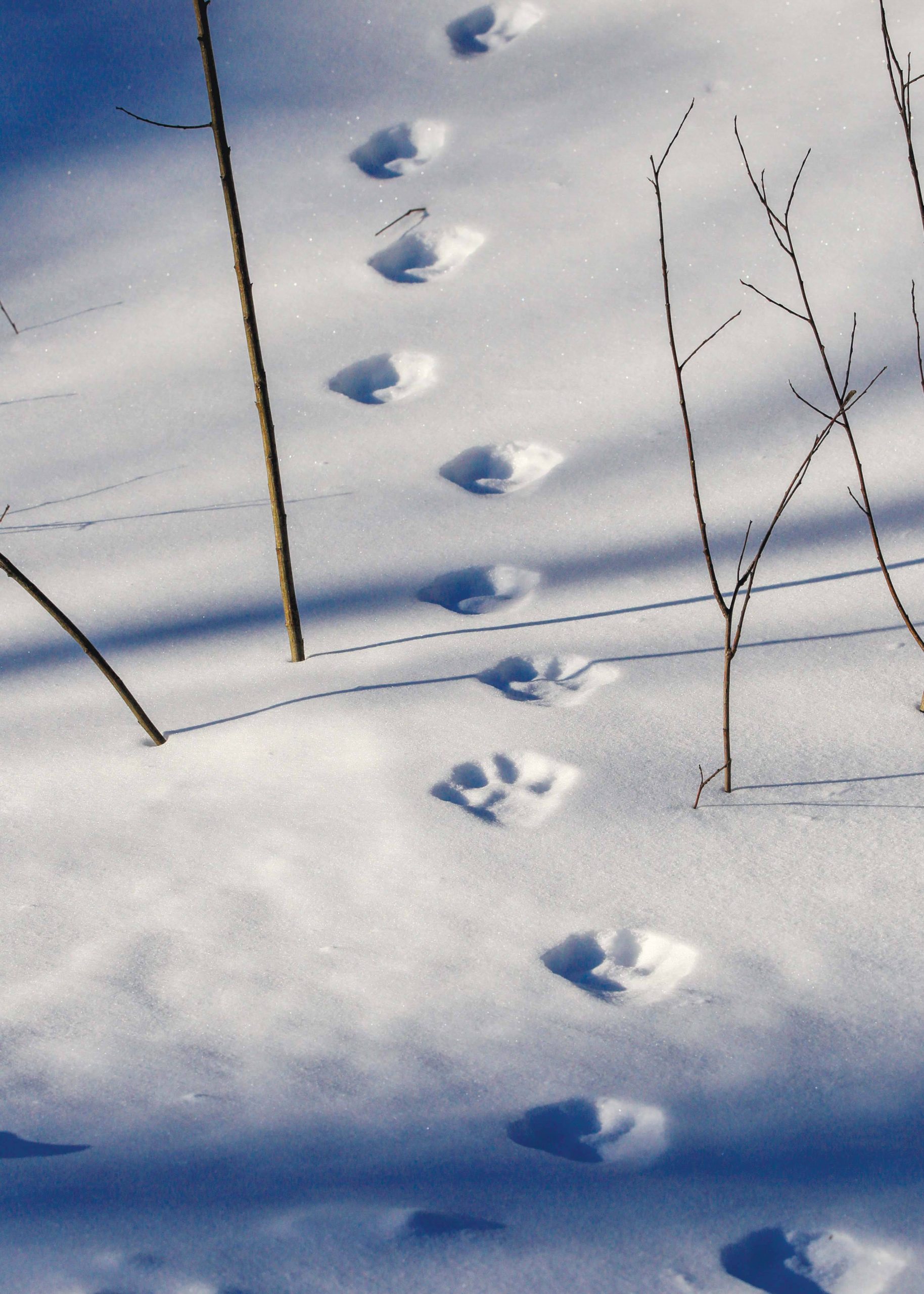
A line of gentle indents reveals where a lynx padded over snow. | KEITH CROWLEY
I am bent over double, leaning on my ski poles, piecing together the drama. It is all here, writ large in a four-foot square of disturbed fresh powder. A measured and confident line of grouse tracks, suddenly truncated. A dozen feathers scattered daintily in a rough circle, curled like small leaves on the snow’s surface. The first puff of wind will send them off. A crimson blotch of blood so bright against the sun-struck white it makes me blink. Two sets of broad wingstrokes fanning the snow, set three feet apart, rhythmic and muscular — there, and there.
It must have happened in the last hour or two. New snow fell during the night, the tracks are still sharp and defined, the red blood is vivid as undried paint. A blue grouse, perhaps, emerging from its night’s burrow under layers of insulating snow, going abroad in search of buds to glean or a branch lit with the first rays of sun to warm up on.
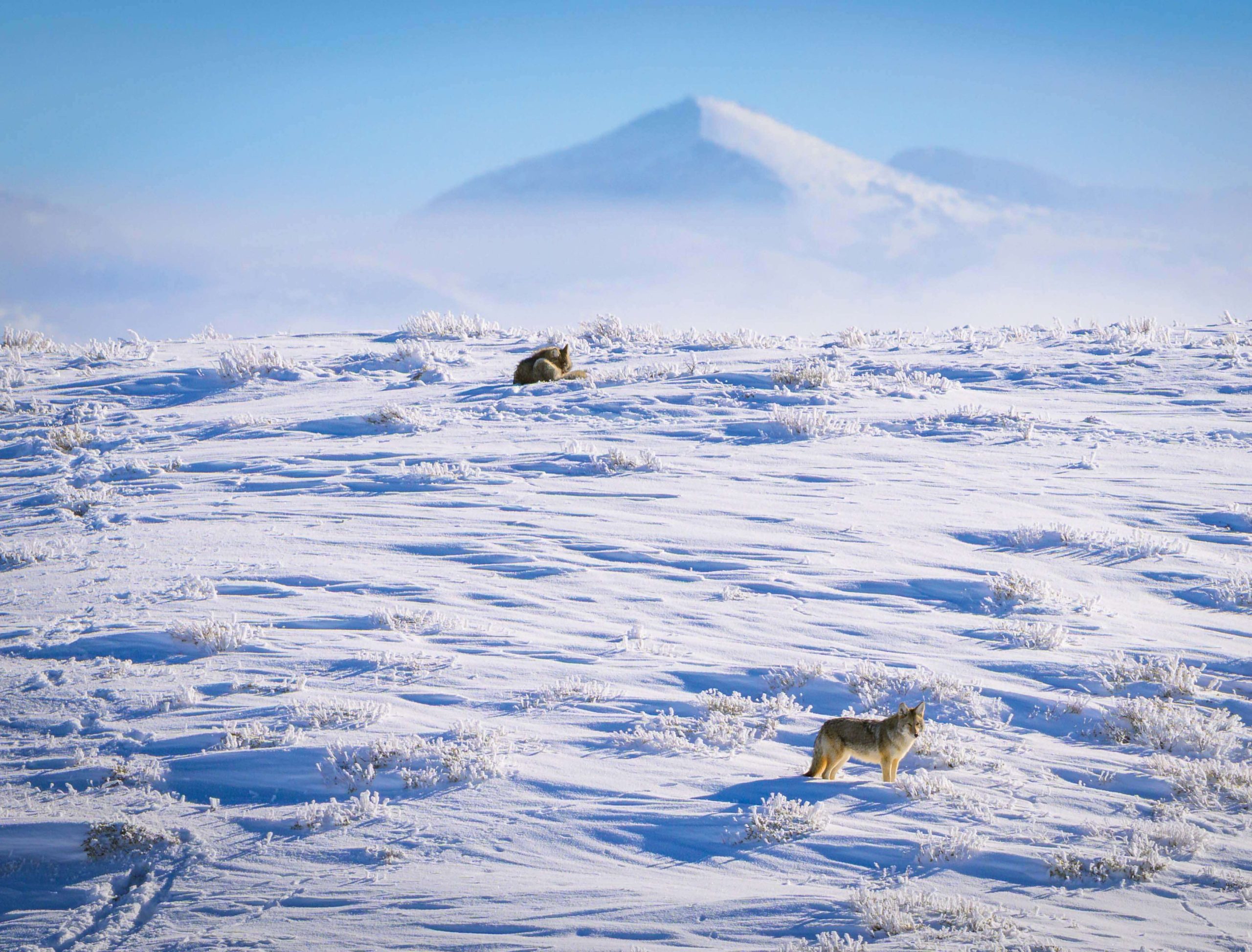
Coyotes crisscross Hayden Valley in Yellowstone, contributing to the conversations played out in the snow. | KEVIN LEAGUE
A great-horned owl, or a great gray, for that matter, in the high limbs of a nearby Douglas fir. The owl’s eyes focus, its feet shift on the branch. Then the predator falls forward, pitching down, and the wide gray wings unfold. The feathers on the owl’s soft, flexible wings are engineered for stealth. Tiny barbs on the leading edge of its primary feathers project just enough to break up the rush of air during a dive. It plummets silently through the crystalline dawn air, talons outstretched and spread wide. It slams into the grouse. Claws pierce deep, blood spurts.
Feathers burst from the struck bird, then sift quietly to rest. The owl labors into the air, flies heavily toward a broken stump, with the dying grouse dangling like a soft purse beneath it.
There are times, in the winter, when I can hardly get anywhere for the stories in the snow. Every few strides on my skis, I am arrested by another set of tracks, an elk bed, wing marks, weasel tunnels. The rest of the year, without the aid of snow, it’s as if nothing much happens. A red-tail might scream overhead, squirrels will scold raucously from a branch, a mound of berry-filled bear turd confronts me on the trail, but most of the time I don’t notice anything noteworthy.
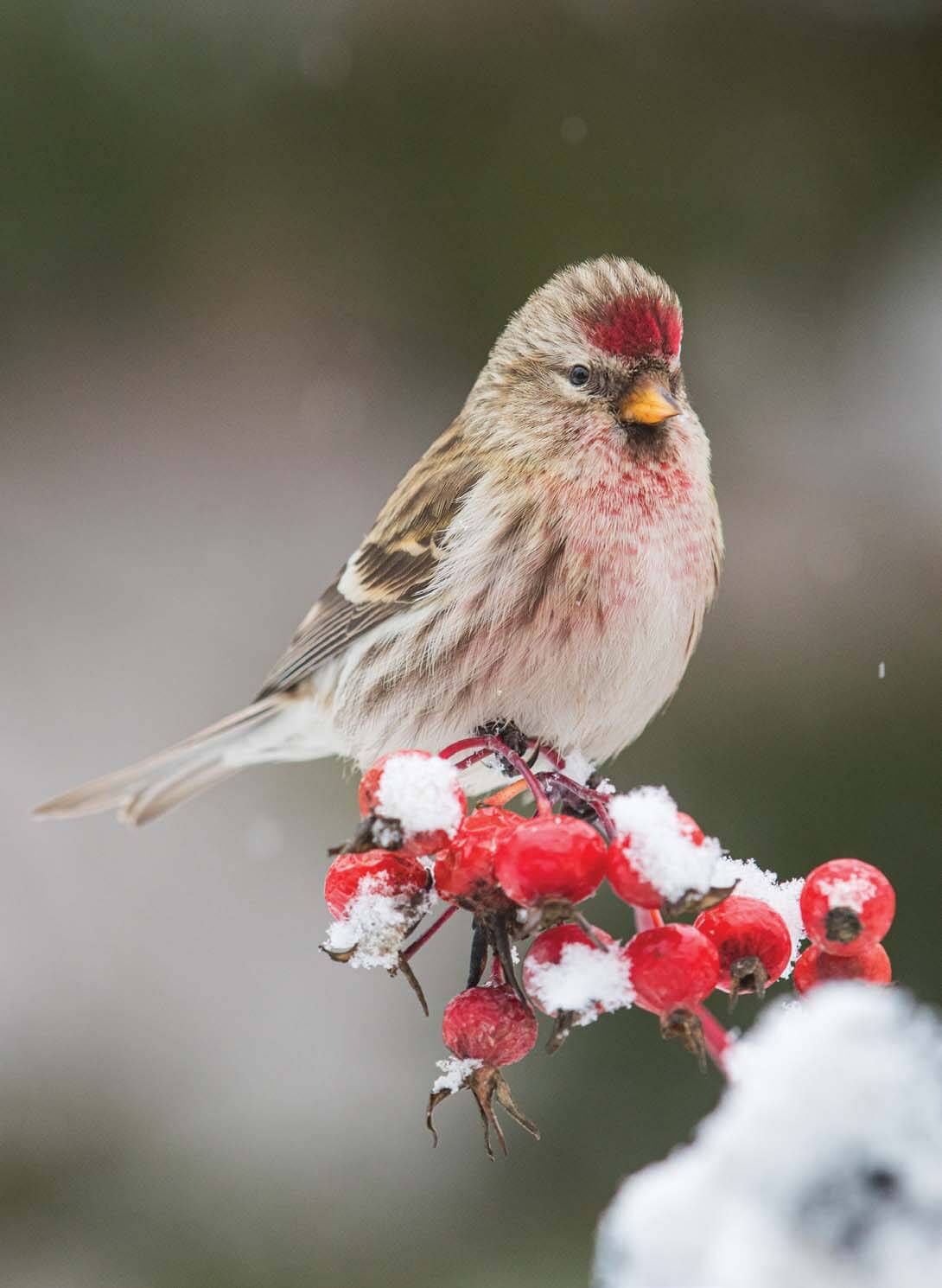
Winter provides visual awareness of the life around us. Here, a common redpoll finch stands out among the season’s muted tones. | DONALD M. JONES
When the snow falls, though, I am bludgeoned with the life and drama everywhere around me. And I am bludgeoned with the awareness of what a sensory dullard I am. No wonder we get in trouble in the outdoors as often as we do. We might as well blunder around wearing headphones, nose clips, and blinders. We should be sent to the back of the class with dunce caps till we learn to behave better.
I know I could act with more decorum. I could scent the wind more often, notice its direction. I could hear the calls of birds, see the bent grasses, notice the fresh claw marks eight feet up an aspen trunk, see where elk have rubbed their velvety antlers, smell a coming storm in the first stirring of wind. But mostly I trudge ahead, preoccupied with the stuff of life that has no business dragging itself along to the blank places on maps. It takes a lightning bolt to wake me from my trance.
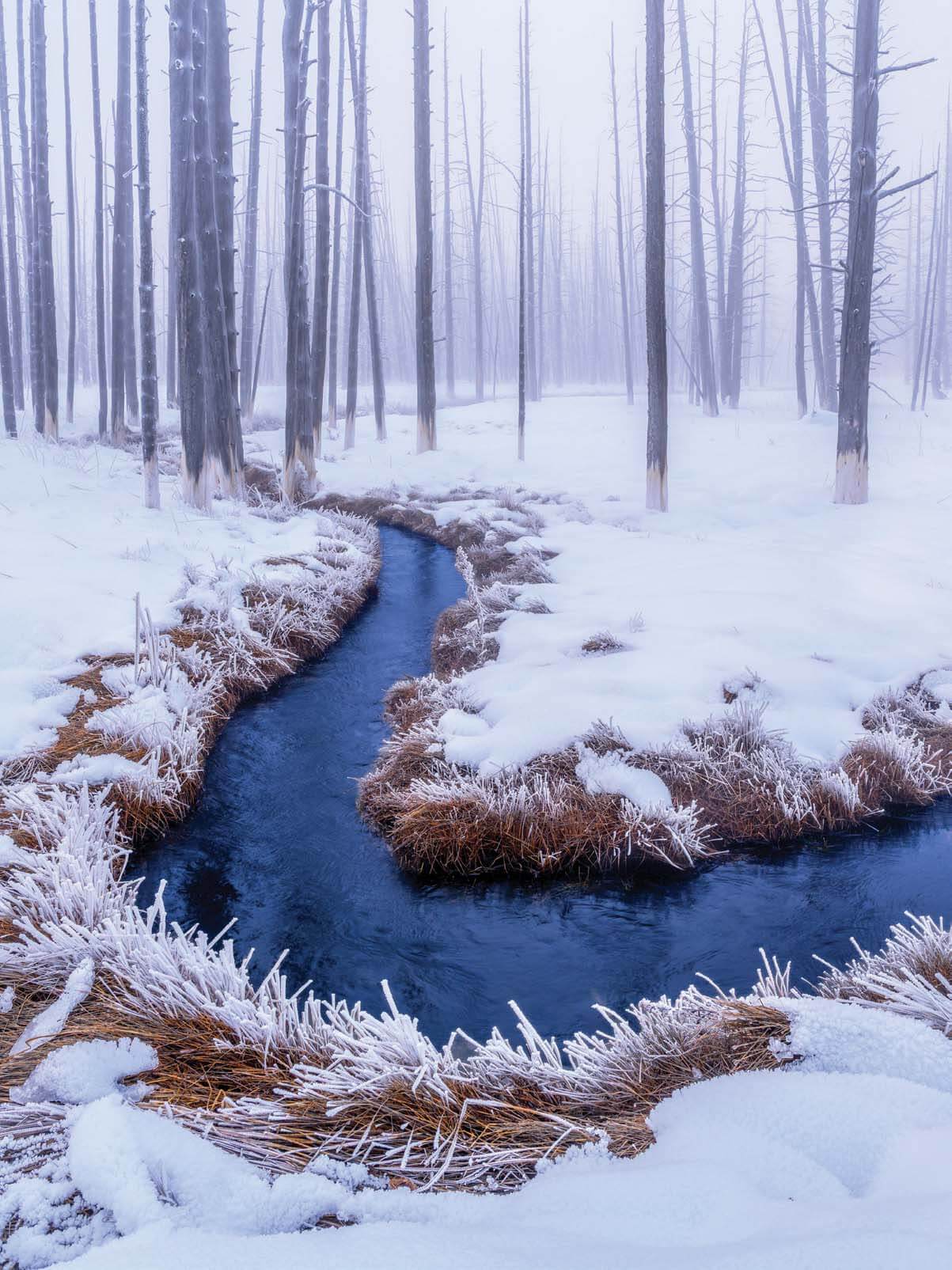
A sinuous bend of Tangled Creek leads deep into Yellowstone’s interior, where silica-rich geothermal water transforms the forest into pale, sculpted forms. | KEVIN LEAGUE
Or it takes winter. And snow. Then the territory suddenly sprouts its news all over the place in messy, overlapping patterns. The backcountry erupts with hunting trails and watering holes and killing grounds and bedding circles and breathing holes and muskrat dens. I am in the midst of the hungering, joyous, hot-breathed, stealthy, implacably unfolding mystery that is always there, but only seasonally available to the sensory impaired.
The maps that draw themselves again and again in snow are as good a reason as I can think of to live in a place with frigid winters. They are my seasonal reminder to listen up, look sharp, pay attention. Without them, it would be easier than it already is to think of myself as alone in the wilds. Snow reminds me that I’m never alone; that there just aren’t any people around at the moment.
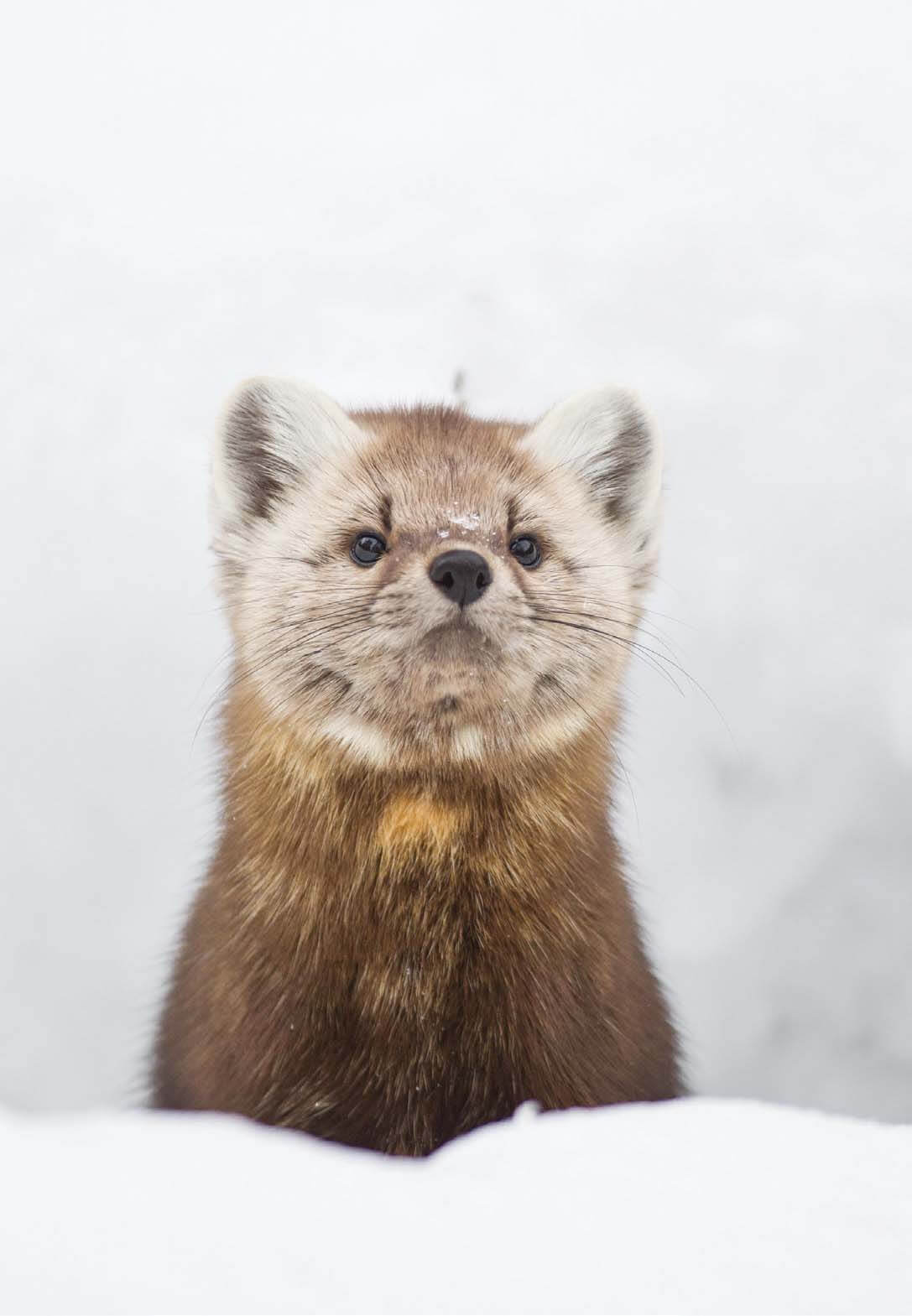
During lean winter months, the cat-sized pine marten searches out a variety of meals. | DONALD M. JONES
Besides, they are as instructive as maps drawn on paper. For someone who needs all the help he can get outdoors, tracks in snow are the cheat notes to wilderness revelation. With their clues I can figure out who lives in the neighborhood, where they travel, who’s eating whom, where the bedrooms are, whether the bears are out yet.
One day in March, I skied along the edge of a winding stream. It was a crisp morning. New overflow ice had frozen into a smooth, seamless surface to stride along. Half an inch of big new snow crystals coated the river. Sunlight glanced off of them like sparks from a flint. Alongside my ski trail, and going the opposite way, were the tracks of a pair of river otters. Their galloping stride alternated with smooth belly slides that were eight, twelve, fifteen feet long — mile on mile. Two otters eating up distance, side by side, purposeful, breathing hard, singing along the new ice like kids with their first skateboards.
I don’t know what they were doing. Maybe, that time of year, they were searching out a den. Maybe they were looking for new fishing grounds or holes in the ice or a good bank to slide down. Maybe, like me, they were out enjoying the sharp morning, noticing the way the days were lengthening, hearing the water already gathering its spring voice under the rigid armor. Feeling alive and strong and glad, like winter hadn’t really been that long after all.
PATTY BAUCHMAN
I do know that their tracks were a kind of companionship. The otters were long gone, busy elsewhere, but I felt them with me there under the cold, gauzy sky, following the ribbon of ice across the snow-muffled willow flats. They were good company, too — quiet, sure, unobtrusive. Better than lots of humans I can think of.
All winter long, the patterns interweave, stories play out, become stale news. Game trails get hard packed and icy, old snow is littered with pine cone shards and bits of fur, pee spots, the hard bowls of elk beds. New snow falls. Even the tiny tracks — the paw prints of mice and voles, their tail drags as thin as thread — are etched in powder. Layer on layer, the maps lay themselves one on another through the bitter, gray-lit months, a living and dynamic topography, the terrain of a season.
When spring comes, the stories fade away. Tracks once sharp and true soften at the edges, become indistinct blobs, abstract forms. For a time, the trails and prints and beds resist while the unmarred snow melts off. There is a period, then, when the community business of a winter stands out in relief, to be read on your hands and knees with your fingertips, like Braille.
In places where I have been again and again through the cold season, where I came, in some crude sense, to know the neighborhood, the thaw is a time of loss. It is as if not only the snow disappears, but the fierce and vibrant life itself slips away, into that obscure netherworld that is, I know, as alive and brimming with news as ever. But I am too obtuse to notice.
No Comments